Previous Himalayan Art Award recipients standing with Margie Thomas and Sangeeta Thapa at Siddhartha Art Gallery. Left to right: Tashi Lama, Bidyhaman Tamang, Anil Shahi, Margie Thomas, Sangeeta Thapa, Muna Bhadel, Kailash Shrestha, Sujan Dangol.
Since 2008, the AHF Himalayan Art Award has celebrated and supported the extraordinary creativity and rich cultural contributions of emerging Nepali artists. Born from a deeply personal tribute and brought to life in partnership with Kathmandu’s Siddhartha Art Gallery, the award has become a prestigious and transformative force in Nepal’s art Scene.
We spoke with Margie Thomas, the award’s creator about the story behind its founding, the impact it’s had on artists’ lives and why she believes cultural expression is one of the most powerful legacies we can preserve.
Can you share how the idea for the AHF Himalayan Art Award first came about? What inspired its creation?
My dearly loved artist friend Murray Zanoni who spent time in the Himalaya drawing and painting passed away unexpectedly in 2008. He entrusted me with the small cash legacy and I wanted to establish something in his memory to support young artists. It was important to do something meaningful with the money.
How did the partnership with Siddhartha Art Gallery in Kathmandu come to life, and what has it meant for the award.
I was spending a lot of time in Nepal for work and after Murray’s death, I came up with the concept of an award to support upcoming artists. Serendipitously, I was introduced to Sangeeta Thapa, owner of the Siddhartha Art Gallery at Babar Mahal Revisited (a complex of restaurants and boutiques). We immediately bonded over the concept and moved quickly from that point to establishing and awarding two young artists, Sushma Sakya and Kailash Shrestha, with the inaugural awards. None of this would have happened without Sangeeta’s dynamism, dedication and passion. She is a force of nature and enormously respected in the art world well beyond the borders of Nepal.
The structure was simple and sustainable after the initial seed money was donated from Murray’s estate. We gave each artist $2,000 on the understanding that in the ensuing year they would produce a body of work to be exhibited at Siddhartha Art Gallery. AHF had the right to choose one major and one minor work from each artist and the remaining work was for sale at the gallery, which generated further income for the artists. I brought the two paintings back to Australia where they were auctioned at fundraising dinners in Sydney and Melbourne - with outstanding success. Kailash’s major work was purchased for a significant sum in Sydney by a philanthropic art collector, and Sushma’s equally beautiful work sold at a Melbourne fundraising dinner. This meant we had the means to keep the art award running year on year, and in some years, expand it to further recipients.
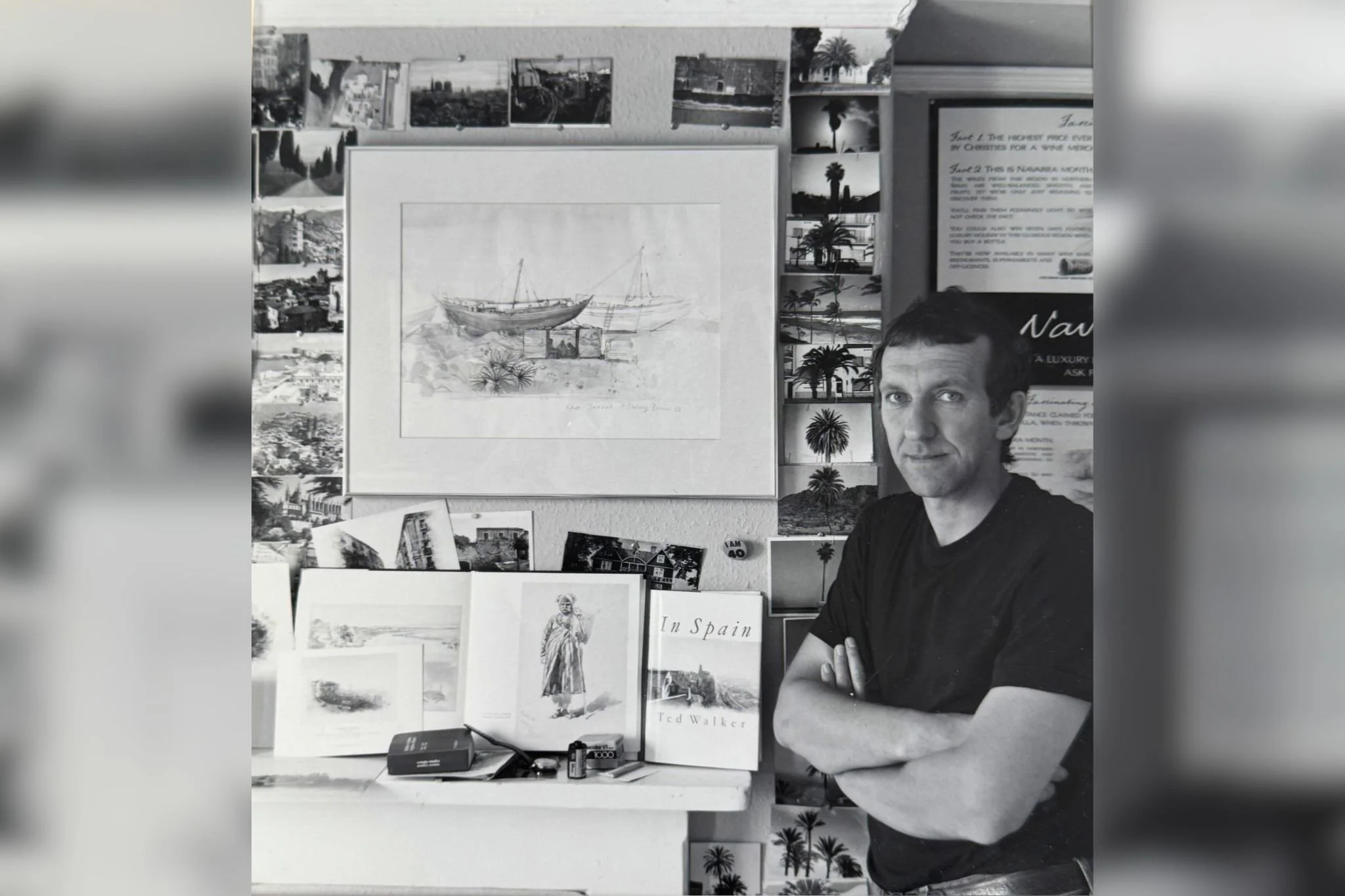
Murray Zanoni in front of his water colour works.
How is the AHF Himalayan Art Award regarded within Nepal’s arts community, and what kind of impact has it had on the careers of past recipients?
The AHF Himalayan Art Award is regarded as prestigious among the art community in Nepal. It is championed by Sangeeta Thapa who has mentored many, many young artists over the 17 years we’ve worked together. She leaves no stone unturned in terms of discovering talented artists and encourages, advises on and critiques their work on an ongoing basis.
The award has been a springboard for so many of the recipients, catapulting them onto another level of prestige, confidence and experience, while providing that critical financial support. Having AHF Himalayan Art Award recipient on your CV added a level of kudos and recognition which helped the artists. With Sangeeta’s support, recipients have been invited to exhibit all around the world. For example, one of the recipients, Hitman Gurung’s work was purchased by the Queensland Art Gallery of Modern Art. You only have to look at the AHF website to read many more stories of success achieved by our past recipients.
Nepal is a country of extraordinary ethnic diversity. How is this recognised and celebrated through the AHF Himalayan Art Award?
The recipients of the AHF Himalayan Art Award are chosen based on their portfolios of work. Their ethnicity doesn’t come into play in the selection criteria. However, as you say, Nepal is incredibly diverse culturally, and this is reflected in the themes of artists’ work. Religion, politics, the caste system, human trafficking, migrant labour, family traditions and respect for elders and also the environment, have featured loud and clear over the past seventeen years. As have issues like struggles with identity, hypocrisy, political corruption, inequality of the sexes and challenges mentally. Art is a channel where many of these topics can be explored, exposed, challenged and taken out to a wider audience. In a way, it is society’s loud hailer.
You’ve been part of the selection panel since the beginning. Over that time, what changes or trends have you seen in the artists and their work? What continues to stand out to you?
Overall, creativity has no bounds, with each year bringing to us portfolios brimming with talent, increasingly refined technique, sophisticated thinking and most importantly courage to speak out and challenge society’s accepted norms.
What is it that you love most about the Nepali art scene? What keeps you personally connected and inspired by it?
Without a doubt, it is the artists, and my ongoing working relationship with Sangeeta. I visit Nepal each year and meet with Sangeeta to catch up on what’s going on - which is always a lot! The AHF Himalayan Art Award recipients are without exception incredible young people, and the loyalty, appreciation, warm friendship and respect they’ve shown to me is deeply moving, valued and reciprocated. I love seeing what they’re doing, where they’re going and how their work is progressing. The art scene in Kathmandu is a vibrant force for expression, change and beauty.
In your view, why is it so important to support and preserve cultural expression in the Himalayan region?
When all is said and done, after political upheaval, wars, coups, environmental disasters, and the frailty of being on this planet, to me it is art that tells the story, that reminds us of where we’ve been, what we’ve been through, and in some instances, where we’re headed. Globalisation is inevitable but it’s critical to remember that what makes us unique is our precious culture, our unique traditions and our history.

Margie Thomas, Sangeeta Thapa and AHF Board Member Felicity Volk at Siddhartha Art Gallery in Kathmandu.
How has the AHF Himalayan Art Award evolved and grown over the years since it began?
It was never intended to make this award complicated or too ambitious. Murray was a ‘grassroots’ sort of person who never got too big for his boots, despite international success. I’ve aimed to keep that sentiment alive through the AHF Himalayan Art Award in his memory. The structure as it is, works well, is honest and transparent, and easy to manage from afar, with the incredible input and advice from Sangeeta. Without her, it would not work. Having said that, Sangeeta fiercely champions these young artists beyond the award to further their careers and open up international opportunities to exhibit their work.
In what ways do you think the AHF Himalayan Art Award helps build connections between Australians and Nepali culture?
I remember a friend, who has a senior role with a prominent American NGO in Nepal, commenting that he wished they had a program like the AHF Himalayan Art Award, because it has generated so much goodwill and good PR for the artists and the Australian Himalayan Foundation. I enjoy thinking about all those fantastic works of art that now adorn the walls of homes in Australia, keeping the warm relationship between our two countries close and appreciated.
What are your hopes for the future of the AHF Himalayan Art Award, and for the next generation of emerging artists in Nepal?
Freedom of expression is the first thing that springs to mind, and I certainly hope that Nepalese artists continue to express their often challenging views via their art. Along with this, I love the celebration of culture that I’ve seen in the work over the years. A classic example is the work of Muna Bhadel who exhibited last year. Her paintings celebrated her elders in exquisite, finely-executed paintings of grandmothers. Bidyhaman Gurung’s work was inspired by climate change and the impact that’s having on insect life. An earlier recipient exhibited an incredible installation art piece reflecting the pollution of the holy Bagmati River. This is powerful stuff. After the catastrophic earthquakes that devastated Nepal in 2015, Kailash Shresthra, one of our inaugural award recipients, ran art workshops for traumatised children. These artists are so inspiring in the way they give back to their communities. I have nothing but the deepest respect for them.
I’m confident there are exciting times ahead for us all.