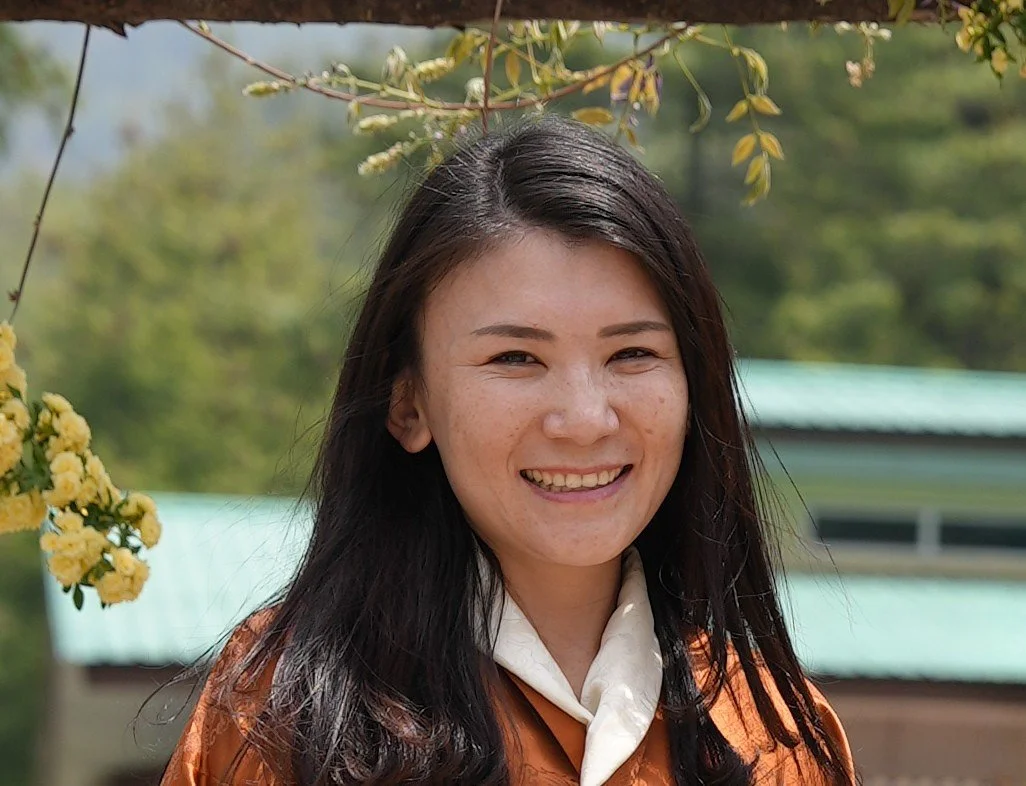
Kuenga Lhaden, Program Manager at RENEW, the Australian Himalayan Foundation’s partner in Bhutan.
Content note: The following article discusses topics including gender-based violence, sexual violence and child abuse.
For Kuenga Lhaden, understanding the work of RENEW and the Australian Himalayan Foundation begins with understanding Bhutan itself. As a Project Manager at RENEW, Kuenga has spent the past year and a half working closely with AHF to support a student scholarship program that has been running since 2011. Through this long-standing partnership, vulnerable children are supported to continue their education, while also receiving counselling and psychosocial support.
In this story, Kuenga shares her personal perspective on a rapidly-changing Bhutan, the values that continue to shape the country, and the work RENEW is doing to support women and children to build safer, more hopeful futures.
Kuzu Zangpo la. My name is Kuenga Lhaden, Project Manager at RENEW, The Australian Himalayan Foundation’s NGO partner in Bhutan.
Imagine a place where the highest mountain has never been climbed not because no one can, but because the people believe it is sacred. Imagine a country where forests are protected not just by policy, but by the Constitution itself. Where there are more trees than traffic lights. And where television and the internet only arrived in 1999. That country is Bhutan.
People from around the world often know Bhutan as ‘the country of Gross National Happiness’, but there is far more to our story. For centuries, Bhutan remained largely isolated from the rest of the world, developing at our own pace while tightly holding our culture, traditions and values. Even today, the idea that development should improve not just our economy, but the wellbeing of our people and the environment around us remains deeply important.
These values also shape our work at RENEW. However, to understand this, it helps to first understand Bhutan.
The Himalayan Kingdom of Bhutan
In 1972, His Majesty Jigme Singye Wangchuck, became king at just 16 years old after the sudden passing of his father. Unlike most young monarchs, he believed that the future of Bhutan should never depend on the wisdom of a single person, even a well-intentioned king. So, little by little, he began transferring power to the people. By the 1990s, he had already started reducing his own authority, and by 2008, Bhutan had held its first democratic elections and officially became a constitutional democratic monarchy.
I sometimes tell people that democracy in Bhutan wasn't demanded from the streets, it was given from the throne. And I think that says something profound about the values our country was built upon.

Modern Bhutan
Bhutan today is changing rapidly. Like many countries, we're seeing increasing urbanisation, changing family structures and a growing number of young people leaving to build their futures abroad (in fact, Australia is now home to the largest Bhutanese population outside of Bhutan).
My generation has watched Bhutan change from a country with no TV or internet to one that is deeply connected to the rest of the world. Young people today have bigger dreams, more opportunities and greater exposure than ever before.
When people hear about Bhutan and the concept of Gross National Happiness they sometimes assume Bhutan has solved all of its social problems. It hasn’t.
Beneath its natural beauty, strong traditions and international reputation, lies a stark reality: women and children continue to experience violence, abuse and systemic inequality.
Creating a safer Bhutan
Gender-based violence is a significant challenge in Bhutan. While one in three women worldwide experience violence in their lifetime, in Bhutan, two in five women experience intimate partner violence. 65% of Bhutanese women believe our country has achieved gender equality, however, more than half also believe a husband may sometimes be justified in hitting his wife. It reminds us that while policies can change, changing deeply rooted social norms takes much longer.
For many women, especially in rural communities, the barriers to seeking help remain significant. Distance from support services, fear of being judged by the community, financial dependence and concern for children can all make leaving an abusive relationship incredibly difficult.
The challenge also extends across generations. Nearly 7% of Bhutanese women report experiencing sexual violence during childhood, and children who grow up around violence are more likely to experience or perpetuate it later in life.
For RENEW, this means gender-based violence is not only a women’s issue. We see it as a community issue, a child protection issue, a public health issue, and ultimately, a development issue. Supporting survivors is important but preventing violence before it happens is equally essential.
About RENEW
RENEW, which stands for Respect, Educate, Nurture, and Empower Women was founded in 2004 by Her Majesty Gyalyum Sangay Choden Wangchuck with a simple belief, that every woman and child deserves to live free from violence, fear and discrimination.
Today, RENEW supports women, men and children affected by domestic, sexual and gender-based violence through counselling, legal aid, emergency shelter, child protection, education, livelihood support and community-based prevention. Since 2004, RENEW has provided more than 326,000 services to nearly 10,000 women, men, and children across Bhutan.
However, RENEW doesn’t measure success simply by the number of cases we handle but by what happens after the crisis. Can a child stay in school instead of dropping out? Can a survivor earn her own income and regain her independence? Can a family break the cycle of violence so that the next generation grows up differently? These are the questions that drive our work every day.
For children who have experienced violence or whose home circumstances have been disrupted, continuing their education is an important part of rebuilding their future. This is where our long-standing partnership with the Australian Himalayan Foundation has become so meaningful.
Partnership with the Australian Himalayan Foundation
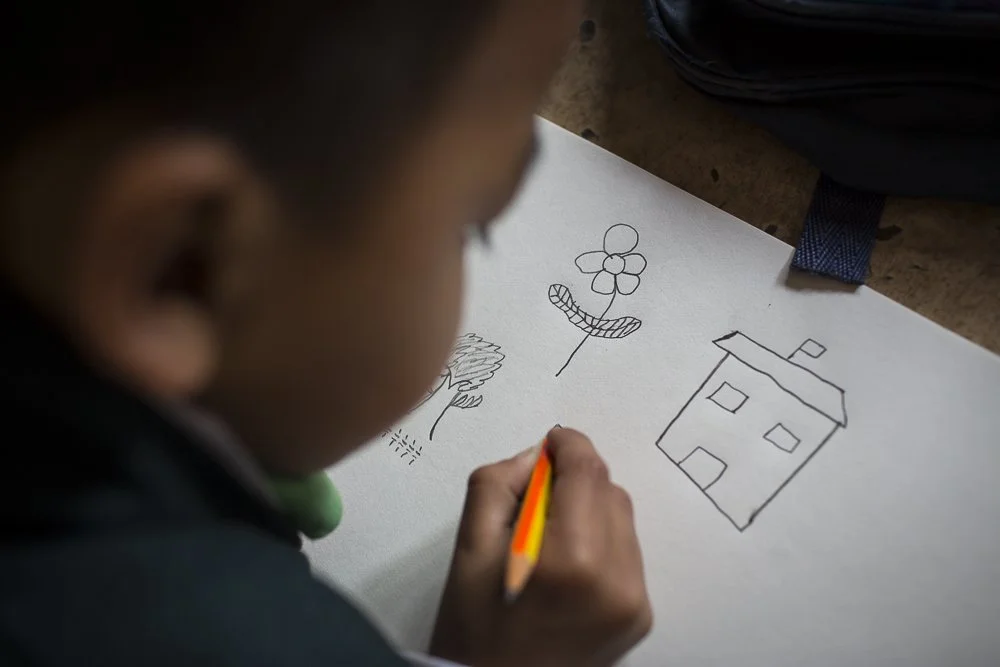
Since 2011, the Australian Himalayan Foundation has been supporting RENEW’s scholarship program, helping children whose lives have been affected by violence, abuse or neglect. The goal is not simply to help children stay in school, but to support their wellbeing and give them the opportunity to continue into further study, vocational training or employment.
Each child receives practical assistance with the everyday costs of education, including uniforms, stationery, transport and toiletries, alongside counselling and psychosocial support from RENEW’s counsellors. Children are monitored through RENEW’s network of case managers and wellbeing focal people within their schools. Alongside this direct support, AHF has also worked with RENEW to strengthen the organisation’s capacity to provide these services.
The program has evolved significantly since the partnership began in 2011. Initially, the focus was largely on helping girls from low-income households overcome the financial barriers to attending school.
AHF and RENEW recognised that the scholarship could play a more targeted role. By 2019, the program had been redesigned to prioritise children whose education had been disrupted by domestic or gender-based violence, or children who had come into RENEW’s care through Gawailing Happy Home. This allowed the scholarship to complement other programs emerging in Bhutan rather than duplicating them, while also focusing AHF’s support where it aligned closely with RENEW’s expertise.
The program also grew beyond the practical costs of education. As RENEW’s counselling capacity developed, counselling and psychosocial support became an integral part of every child’s scholarship. The experience of the COVID-19 pandemic further reinforced the importance of supporting children’s mental health alongside their education.
Today, the program supports 178 children across 19 districts — 99 girls and 79 boys. What began as a small grant to help with uniforms and stationery has become a much more integrated program combining education, counselling, child safeguarding and organisational strengthening.
Importantly, the programme has never remained fixed. AHF and RENEW have continued to learn from children, families and staff, using these insights to shape the next phase of the partnership.
For AHF, this reflects the value of a long-term partnership. Rather than simply funding a project, the relationship with RENEW has allowed both organisations to listen, learn and adapt with the shared goal of helping vulnerable children stay in school, improve their wellbeing and build greater opportunities for their futures.
Impact of the program
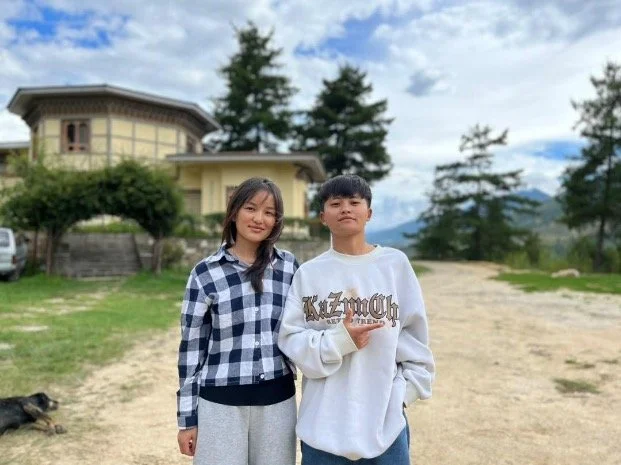
I'd like to end by sharing the story of two remarkable young women, Pema and Tashi*.
In 2015, both girls came to RENEW's Gawailing Happy Home after losing each of their parents. Gawaling Happy Home is a sanctuary for children and women who have experienced domestic and gender-based violence, or who have unstable home lives. Run by RENEW, the home’s purpose is to provide refuge and help its residents to regain their independence and children to flourish and fulfil their potential. At such a young age, they had already experienced more hardship than most of us could imagine. But what they found at Gawailing Happy Home wasn't just shelter. It was a safe place to heal, continue their education, and begin believing in a future again.
Today, more than a decade later, they are both pursuing their tertiary education at Royal Thimphu College, having been supported by the Australian Himalayan Foundation’s scholarship Program.
Pema told us,
"Receiving the AHF scholarship has allowed me to continue my studies without placing an extra burden on my family. I hope to make the most of this opportunity and one day give back to my community."
And Tashi shared,
"This scholarship has given me the opportunity to focus on my education and work towards my dreams. It has inspired me to keep learning, work hard and create a brighter future for myself and my family."
For me, these two young women represent exactly why this partnership matters.
A scholarship doesn't simply paying for education. It restores confidence, creates opportunity and reminds a child that their past does not have to define their future.
And I think that's the greatest impact of all.
Read more about our Education Programs.
*Student’s names have been changed to protect their identity.