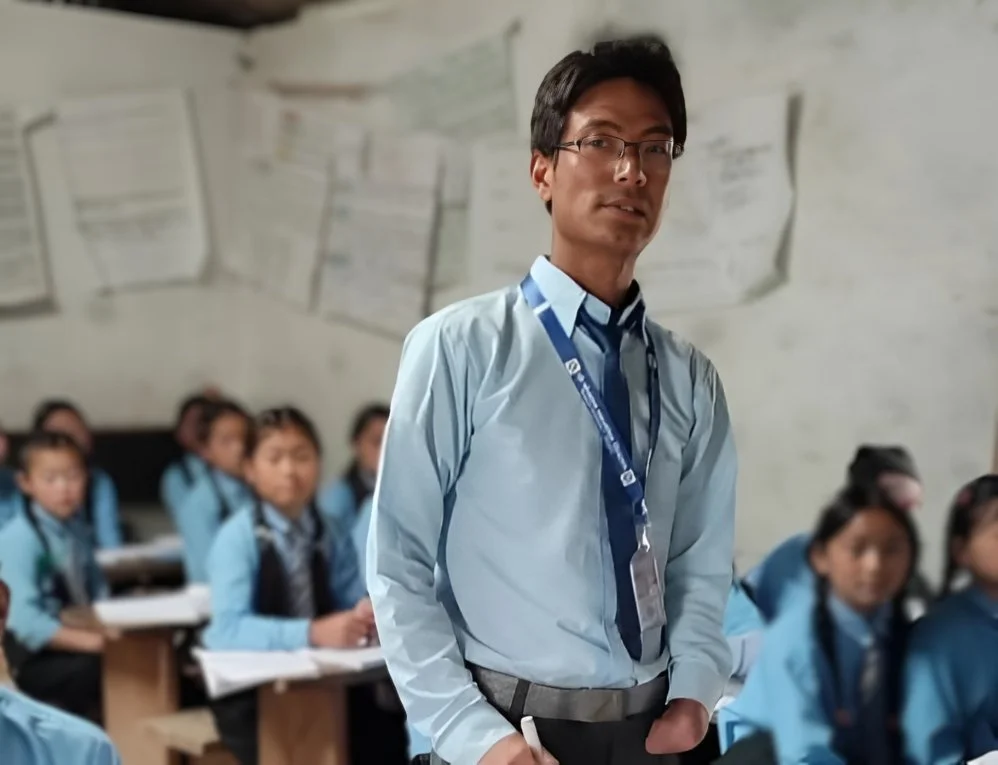
Duparaj’s journey to the classroom
In the remote village of Chheskam in Solukhumbu, Nepal one young teacher has become a role model in his community. At just 21, Duparaj stands as an inspiring figure amongst his students and colleagues. Identified as a candidate for REED Nepal’s Going to School Support program at an early age, Duparaj’s path to the classroom is a powerful example of how targeted educational support can open doors and transform lives.
For Duparaj, the journey to becoming a teacher was full of challenges. Born without fingers on his left hand, Duparaj was the youngest of eight children (and one of four siblings living with a physical disability). He grew up in a farming family that struggled to grow enough food to last the year. With limited income, his parents faced the constant stress of how to support their children’s education and healthcare.
To help his parents, Duparaj worked as a porter in Namche during long school holidays, earning what he could to ease the financial strain.
Going to School Support for vulnerable students
A turning point came for Duparaj in the 5th grade. Through our partner REED Nepal, he was selected to receive educational assistance as part of the going to school support program – an initiative that helps the most vulnerable students (including orphans, children with disabilities, those affected by disasters, and kids from marginalised or low-income families) access the resources and school supplies that they need to attend school. The support covered his essentials like a school bag, uniforms and stationery. For his family, it meant relief and for Duparaj, the ability to pursue an education free from fear of the financial burden on his family.
Today, Duparaj teaches Science and Maths at the local high school in Chheskam. In the classroom, Duparaj believes that his disability and upbringing has given him a deeper understanding of perseverance and empathy. He is also a passionate advocate for inclusive education that better supports both teachers and students with disabilities.
Disability inclusion and access in Nepal
In Nepal, official census data estimates that around 2.2% of the population lives with a disability. In reality, the true figure is likely far higher. In remote regions, disability carries a stigma, often stemming from cultural and religious beliefs. In some cases a disability is seen as a karmic repercussion from actions in a past life. People with disabilities frequently face social exclusion and discrimination. In areas where access to education, healthcare and infrastructure is limited, these barriers are compounded, with many people remaining invisible, underreported and underserved.
Duparaj’s story also reflects a broader shift in approach in Nepal. With support from AHF, REED Nepal is embedding disability inclusion as a cross-cutting priority across all of its education programs. This means ensuring children with disabilities are not only included in classrooms, but that learning environments are also welcoming, accessible and adapted to their needs. This includes working with schools and local governments to conduct early screening to identify children with disabilities and provide them with support and equipment to help them participate more fully at school, physical modifications to schools, inclusive teacher training programs, listening to feedback from children with disabilities and their families, and collaboration with other organisations working to support people with disabilities. In practice, it also means supporting and uplifting people like Duparaj, not just as beneficiaries of the programs, but as leaders and changemakers in their own communities.
Through his role as a teacher, Duparaj is demonstrating that economic disadvantage and physical disabilities do not define a person’s ability to contribute, to lead or to inspire. Once a student at risk of being left behind, he is now shaping young minds and challenging long-held perceptions about disability and inclusion. Duparaj has expressed how the Going to School Support program is a lifeline for vulnerable children and he is deeply thankful to REED Nepal, AHF and our incredible donors for making quality and inclusive education in Nepal possible.
About our Going to School Support program
Part of our wider education program, the Going to School Support initiative helps ensure that underprivileged students have the supplies they need to stay in school. For $150, you can support one student’s education for an entire year with materials including including notebooks, pens, a geometry box, pencils, erasers, a backpack, and personal care items like a towel, shampoo, soap, toothbrush and toothpaste. These essentials, along with financial aid, help students at home and in the classroom to be school ready. Your donation can make a real difference in the life of a student like young Duparaj.
Donate today and help more children access the education they deserve.
Our education program in Nepal is funded by generous Australian Himalayan Foundation donors and the Australian Government through the Australian NGO Cooperation Program (ANCP).
Read more about our Education Programs.